Automating HR Onboarding: From Offer Letter to Day One
Manual HR onboarding costs companies $58.79 per new hire in administrative waste alone. Then add the real cost: 20.5% of new hires quit within the first 90 days because organizations cannot execute onboarding properly. That turnover costs up to 200% of an employee's salary to replace.
I have watched companies transform their onboarding process from paper chaos to automated systems that cut processing time by 53% while improving retention by 82%. But I have also seen HR teams buy expensive platforms that nobody uses because they automated the wrong processes or ignored the human connection that makes onboarding work.
The Old Way vs. The AI-First Way
The Old Way: HR sends offer letters by email. New hires print, sign, scan, and email back forms. HR manually enters data into payroll systems, benefits platforms, and access management tools. IT gets a forwarded email three days before the start date to provision laptops. The new employee shows up Day One with no equipment, no access, and a stack of forms to complete. Only 12% of employees report their organization did a good job with onboarding.
The Old Way costs: Manual onboarding processes cost $58.79 per hire for basic administrative tasks. That breaks down to $11.97 for I-9 processing, $12.86 for contact information updates, and $12.90 for employee agreements. Benefits enrollment adds another $89 per employee. Time management processes cost $113.40 per employee. For a company hiring 100 employees annually, manual onboarding wastes $15,879 just on paperwork before accounting for the time HR professionals spend chasing signatures.
The AI-First Way: Automated onboarding begins the moment the candidate accepts the offer. Digital workflows trigger immediately. The new hire receives a personalized portal with e-signature forms, benefits enrollment, direct deposit setup, and compliance documents. AI-powered chatbots answer common questions about parking, dress code, and first-day logistics. Automated task assignment sends laptop requests to IT, security badge requests to facilities, and training enrollment to managers, all without HR sending a single email.
Companies using AI-powered onboarding reduce manual workload by 53% and cut errors in employee data collection by 73%. New hires using personalized AI-driven training paths show 50% improvement in time-to-productivity. That means employees reach full productivity in 33 days instead of 65 days, cutting the ramp period in half.
The Five-Phase Onboarding Automation Framework
Phase 1: Pre-Boarding (Offer Acceptance to Day One)
Automation begins before the start date. The moment a candidate signs the offer letter, workflows trigger. Digital forms populate automatically with information from the applicant tracking system. New hires complete tax forms, direct deposit enrollment, emergency contacts, and benefits selection from their phone. AI systems validate data in real time, flagging incomplete fields or errors before submission.
BambooHR automatically creates customized checklists based on job role, department, and location. A marketing coordinator receives different tasks than a software engineer. Smart task assignment distributes work seamlessly: IT provisions laptops, HR enrolls benefits, and managers schedule introductions. Predictive analytics identify potential bottlenecks by analyzing historical data, flagging delays in equipment procurement during busy hiring periods.
Phase 2: Day One (First Impressions)
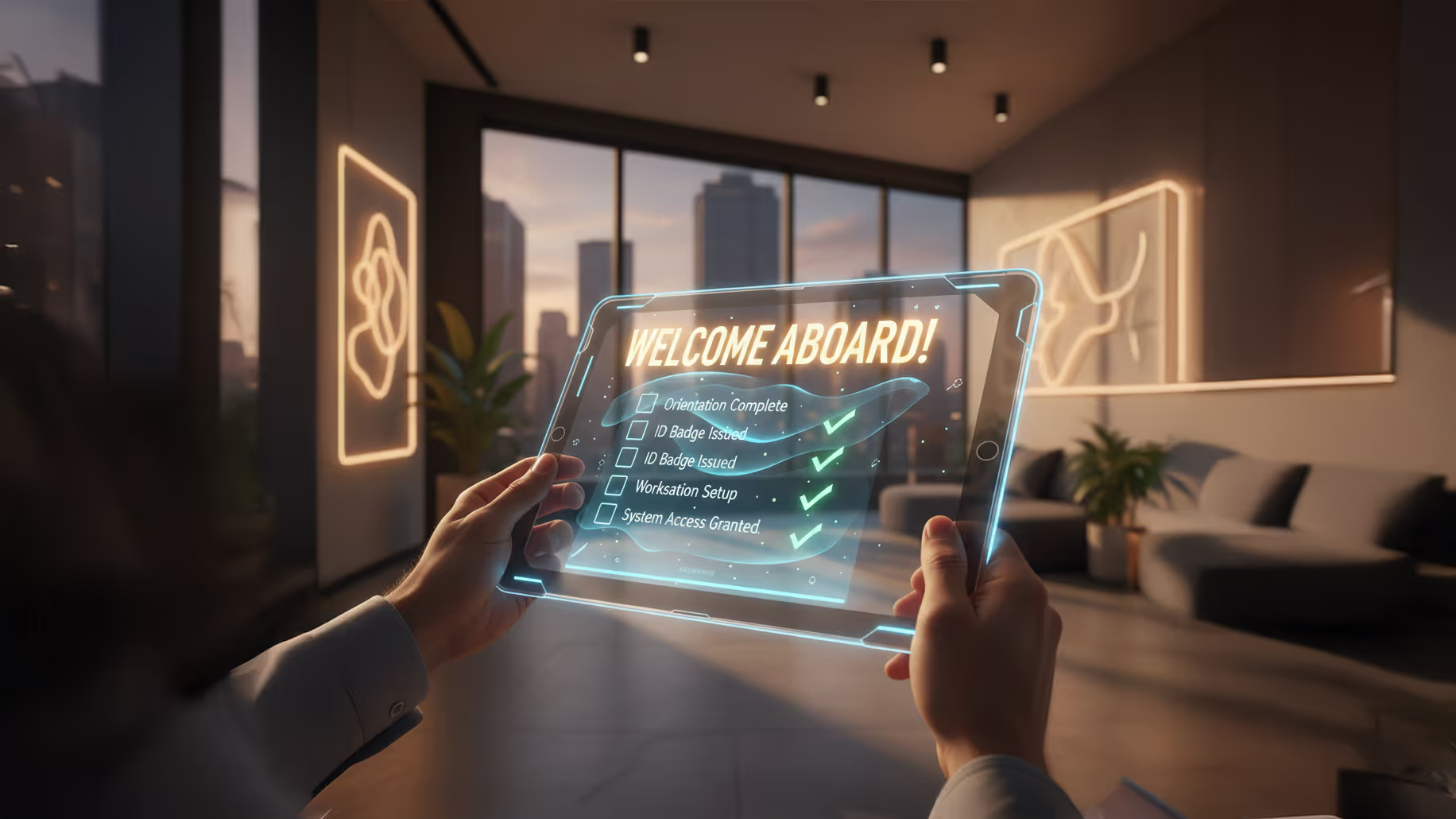
Automated onboarding creates flawless first-day experiences. New hires arrive to find their workspace prepared, equipment ready, and accounts provisioned. Digital welcome packets include org charts, team directories, meeting schedules, and training materials accessible via mobile app. No more scrambling to find a laptop or waiting hours for system access.
AI-powered virtual assistants guide new hires through building navigation, cafeteria hours, and common first-day questions without requiring HR intervention. Automated reminders notify managers to conduct welcome meetings and confirm training schedules. Instead of spending 10 hours per new hire answering questions and processing forms, HR professionals spend 2 hours focused on relationship building and strategic support.
Phase 3: First 30 Days (Knowledge Transfer)
Automated learning management systems deliver role-specific training modules based on the employee's position. AI tracks progress and sends reminders for incomplete courses. Managers receive dashboards showing which training milestones new hires complete and which require intervention. Instead of generic company-wide training, systems deliver personalized learning paths tailored to each individual's pace and knowledge gaps.
Digital check-ins replace manual surveys. Automated pulse surveys at Day 7, Day 14, and Day 30 measure engagement, identify confusion, and surface issues before they escalate. AI analyzes responses and flags employees showing disengagement signals, enabling proactive manager intervention. Companies using these systems see 25% reduction in new hire turnover rates.
Phase 4: 60-90 Days (Integration and Performance)
The 90-day window determines long-term retention. Companies with structured onboarding processes experience 82% higher new hire retention and 50% increases in productivity. Automated milestone tracking ensures managers conduct performance check-ins at 30, 60, and 90 days. Systems send reminders and provide templates for meaningful feedback conversations.
AI-powered analytics identify which new hires are thriving and which are struggling. Predictive models achieve 95% accuracy in identifying disengagement risks by analyzing training completion rates, peer interaction patterns, and survey responses. HR teams intervene early with targeted support rather than discovering problems after an employee resigns.
Phase 5: Optimization (Continuous Improvement)
Automated systems generate data that manual processes never capture. Track time-to-productivity by role, department, and manager. Measure which training modules correlate with higher performance. Identify which onboarding steps cause delays. Use this intelligence to refine workflows continuously. Companies optimizing based on onboarding analytics reduce time-to-productivity by 40% within the first year of implementation.
The Hard ROI: Calculating Onboarding Returns
Automation delivers measurable returns when you calculate the full cost of manual processes. Here is the math:
Administrative cost savings: Manual onboarding costs $58.79 per hire for basic tasks. Automation reduces these costs by 60-70%. A company hiring 200 employees annually saves $7,000-$8,200 per year just on paperwork elimination.
HR productivity gains: HR managers making $50,000 annually earn approximately $24 per hour. Manual onboarding consumes 10 hours per new hire. Automation reduces that to 2 hours, saving 8 hours or $192 per new hire. Across 200 hires, that is $38,400 in recovered HR capacity redirected to strategic initiatives rather than paperwork.
Retention cost avoidance: Replacing an employee costs 50-200% of their annual salary depending on role complexity. If automation improves 90-day retention by even 10%, a company hiring 200 people annually prevents 20 early exits. For employees earning $60,000 annually, avoiding 20 turnovers saves $600,000 to $2,400,000 in replacement costs.
Time-to-productivity improvement: The median time-to-productivity in 2025 is 65 days for knowledge workers. AI-driven onboarding cuts that to 33 days (50% improvement). An employee earning $80,000 annually produces $308 per day in value. Reaching full productivity 32 days faster generates $9,856 in additional output per employee. Across 200 hires, that is nearly $2 million in productivity gains.
The Technology Stack for Automated Onboarding
Onboarding Platforms:
- BambooHR automates checklist creation, task assignment, and document collection with role-specific workflows
- Workday integrates onboarding with payroll, benefits, and HR systems for seamless data flow
- SAP SuccessFactors provides enterprise-grade onboarding with compliance tracking and analytics
AI-Powered Features:
- Chatbots handle repetitive questions about benefits, policies, and logistics 24/7
- Predictive analytics identify disengagement risks with 95% accuracy
- Natural language processing enables conversational interfaces for form completion
- Machine learning personalizes training paths based on role, experience level, and learning speed
Integration Requirements:
Automation only works when systems connect. Link your onboarding platform to applicant tracking systems, payroll providers (ADP, Paychex), learning management systems, and identity management platforms. APIs enable data to flow automatically without manual re-entry. Companies report 60% faster onboarding processing when digital forms replace paper systems.
Build Systems That Scale
HR teams drown in manual onboarding during high-volume hiring periods. Automation transforms onboarding from a bottleneck into a competitive advantage. New hires experience seamless, professional processes that reinforce their decision to join. HR professionals shift from administrative work to strategic talent development.
The companies winning in 2025 recognize that onboarding determines whether new hires stay or leave within 90 days. Poor onboarding leads to 52% of employees feeling let down by their company, 56% feeling disoriented, and 49% feeling devalued. Automated systems eliminate confusion, accelerate productivity, and create consistent experiences regardless of hiring volume.
Do not automate for automation's sake. Start by mapping your current onboarding process. Identify which steps consume the most HR time. Calculate what manual processing costs per hire. Then automate the highest-impact areas first: document collection, task assignment, and compliance tracking. Measure results. Expand to training delivery, performance milestones, and predictive analytics.
Audit your onboarding process today. Track how many hours HR spends per new hire. Calculate your 90-day turnover rate. Then build automated workflows that turn those costs into competitive advantages. The right onboarding automation does not replace human connection. It eliminates waste so HR can focus on what actually matters: helping new employees succeed.
Related Topics
Related Articles