Multi-Agent Systems: How AI Teams Collaborate to Solve Complex Problems
Multi-Agent Systems, How AI Teams Collaborate to Solve Complex Problems
You hired the best engineer you could find. But when you gave them a massive project requiring frontend work, backend architecture, database optimization, and DevOps, they struggled. Not because they were not good. Because no single person can master every domain simultaneously. That is exactly why single AI agents fail at complex business problems, and why multi-agent systems are becoming the standard for enterprise AI deployment in 2025.
The Old Way vs. The AI-First Way
The Old Way: Companies deploy one AI agent and expect it to handle everything. Customer support, data analysis, compliance checks, and process optimization all through a single system. The result? Mediocre performance across the board. The agent gets overwhelmed, makes errors, and requires constant human intervention because it is trying to be an expert in 15 different domains at once.
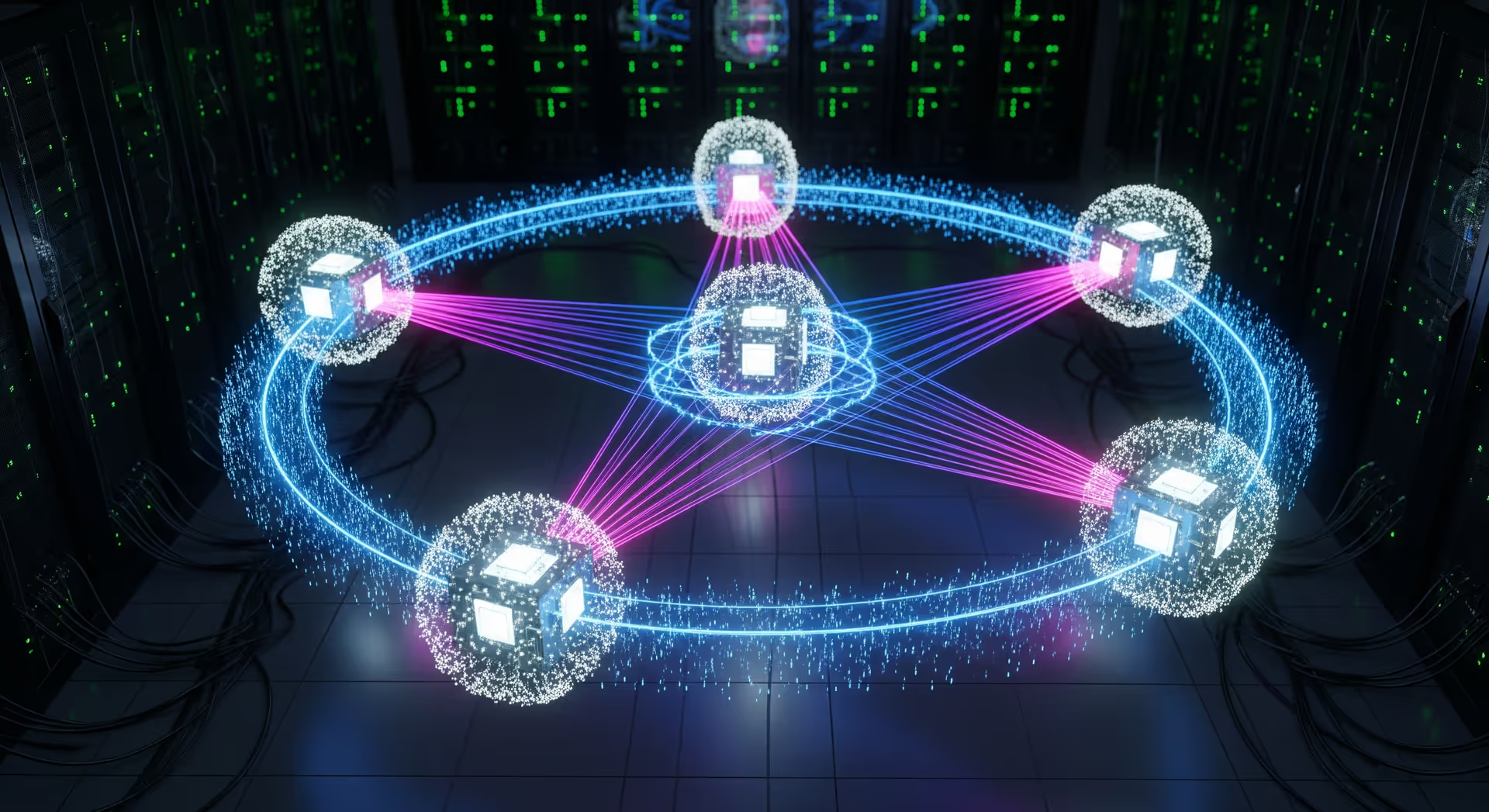
The New Way: Multi-agent systems split complex work across specialized AI agents, each mastering one specific domain. You have a research agent that excels at gathering data. A strategy agent that analyzes information and makes recommendations. An execution agent that implements decisions. And a quality control agent that validates outputs. They communicate, coordinate, and collaborate like a high-performing team.
Here is the difference in practice: JPMorgan had legal teams spending 360,000 hours annually reviewing commercial loan agreements. They deployed COIN, a multi-agent system where different agents handle document parsing, clause extraction, risk identification, and compliance verification. The task now takes seconds instead of thousands of hours. That is the power of specialization at machine speed.
The Core Framework: How Multi-Agent Teams Operate
Multi-agent systems work through three coordination patterns:
1. Hierarchical Delegation
One orchestrator agent receives the high-level goal and breaks it into subtasks. It assigns each subtask to specialized agents, monitors progress, and integrates results. Think of it as a project manager coordinating specialists. When a manufacturing company needs predictive maintenance, the orchestrator delegates vibration analysis to one agent, temperature monitoring to another, oil quality assessment to a third, and production scheduling to a fourth. Each agent reports back, and the orchestrator synthesizes recommendations.
2. Collaborative Problem-Solving
Multiple agents work simultaneously on different aspects of the same problem, then share findings. In financial fraud detection, one agent analyzes transaction patterns, another monitors account behavior, a third checks historical fraud markers, and a fourth evaluates geolocation data. They pool insights to flag suspicious activity with higher accuracy than any single agent could achieve.
3. Sequential Processing
Agents work in pipeline fashion, where each agent's output becomes the next agent's input. A customer support system might route inquiries through a classification agent (identifies issue type), a solution agent (retrieves relevant information), a response agent (crafts the reply), and a quality agent (ensures accuracy before sending). Each step adds value and precision.
The Hard ROI: Real Numbers from Real Companies
The math on multi-agent systems is compelling because the gains are measurable and immediate.
Manufacturing Case Study: A global manufacturer deployed 156 specialized agents across their facilities for predictive maintenance and production optimization. Results after 18 months: Equipment downtime reduced by 42 percent. Maintenance costs decreased by 31 percent. Production efficiency increased by 18 percent. Total ROI: 312 percent. The system paid for itself in under six months and continues generating savings.
Enterprise Efficiency Gains: Companies implementing multi-agent systems report 40 to 60 percent reduction in manual decision-making tasks. Process optimization improves by 25 to 45 percent. Problem resolution speeds up by 30 to 50 percent. Customer satisfaction scores increase by 15 to 25 percent. These are not projections. These are measured outcomes from 2025 deployments.
Cost Per Interaction: Traditional human agents cost between $3 and $6 per customer interaction when you factor in salary, benefits, training, and overhead. AI agents in multi-agent systems cost $0.25 to $0.50 per interaction. Organizations implementing these systems achieve 85 to 90 percent cost reductions on automated interactions, with typical payback periods of six months and annual savings ranging from hundreds of thousands to millions depending on scale.
Tool Stack and Implementation
If you are building multi-agent systems, here are the frameworks leading enterprise deployments in 2025:
AutoGen (Microsoft): Best for conversational multi-agent interactions where agents need to build on each other's insights through dialogue. Enterprise teams use AutoGen for research scenarios, creative problem-solving, and situations requiring iterative refinement. The framework offers strong reliability features and comprehensive documentation, though it requires more initial setup compared to lightweight alternatives.
CrewAI: Designed around role-based architecture that mirrors human organizational structures. Instead of generic AI processors, you define specific roles, responsibilities, and hierarchies. This works exceptionally well for business process automation where you want agents to function like departments (finance agent, legal agent, operations agent). CrewAI makes it intuitive to model how human teams naturally organize.
LangGraph: Ideal for visual thinkers and teams that need rapid prototyping. LangGraph provides visual debugging capabilities so you can see real-time data flow between agents, identify bottlenecks, and modify workflows through visual editing rather than code changes. The platform includes pre-built templates for common multi-agent patterns and integrates with popular AI frameworks for fast deployment.
AgentScope: Built for fault tolerance and distributed systems. If you need multi-agent systems running across different servers, handling high loads, and maintaining performance under failure conditions, AgentScope provides the infrastructure backbone. It is designed for production-scale deployments where reliability is non-negotiable.
Why These Tools Matter: The difference between success and failure in multi-agent systems is coordination. These frameworks handle the hard parts: inter-agent communication protocols, task delegation logic, conflict resolution when agents disagree, and monitoring dashboards so you can see what each agent is doing in real time.
Building Your First Multi-Agent System
Start with a problem that naturally splits into distinct specialties. Customer support is ideal. Deploy three agents: Classification Agent (routes inquiries to the right department), Resolution Agent (solves the problem using knowledge base and past tickets), and Escalation Agent (identifies when human intervention is needed and provides full context to the human agent).
Measure everything. Track resolution time, accuracy rates, escalation frequency, and customer satisfaction. Compare against your baseline. Most companies see 30 percent improvement in these metrics within the first 30 days.
Scale gradually. Add agents as you identify bottlenecks. If the Resolution Agent struggles with technical questions, introduce a Technical Specialist Agent. If customers ask about order status frequently, add an Order Tracking Agent. Build your team the same way you would build a human team: hire specialists as needs emerge.
The companies winning with AI in 2025 are not deploying smarter single agents. They are deploying coordinated teams of specialized agents that collaborate like elite human teams, but operate at machine speed and scale. The question is not whether your competitors are building these systems. They are. The question is whether you will build yours before they capture the efficiency advantage.
Do not just read this. Identify one complex process in your business today and map how a team of three specialized agents could handle it better than your current approach.
Related Topics
Related Articles