
Personalized Video Marketing at Scale: Where Platforms Break
Key Takeaways
- →Platforms re-render one base video per recipient, swapping names, backdrops, or a cloned voice, and never record new footage.
- →Broken CRM fields ship silently as raw placeholders like "Hi {FirstName}," so test your mapping against your ugliest real rows.
- →Voice clones mispronounce uncommon and non-English names most often on name-heavy B2B lists.
- →Most email clients will not autoplay video, so recipients usually get a personalized thumbnail or animated preview with a tracked link.
- →BHuman's Scale plan is $99 a month for 300 videos, which only makes sense at hundreds of sends a month, not a list of 40.
On this page⌄
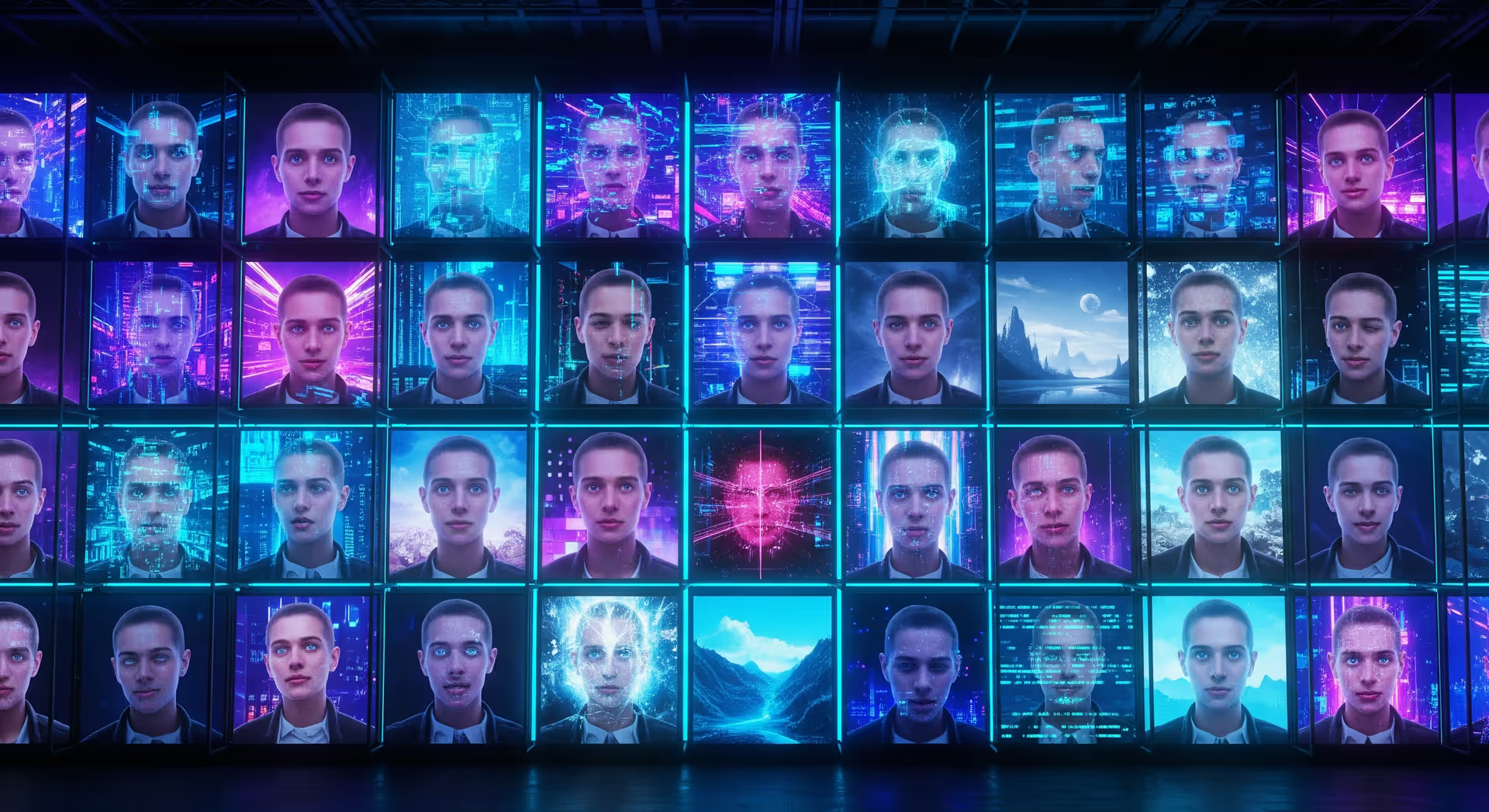
These personalized video marketing platforms never record a separate clip for each recipient. You film a single video once, and AI swaps in a name, a company, or a backdrop image, and sometimes re-records the swapped words with a voice clone made from your own voice. That is the whole engine behind every vendor in this category, from the most basic merge-field tool to the ones sold as "AI-generated." Knowing how that engine works, and the places it falls apart, matters more than any sales demo.
Every organic result on this topic right now is a vendor pitching you their version of that engine. None of them will point out where it fails. Here is the engineering perspective: what these tools do beneath the surface, the failure modes that surface once you grow past your first hundred sends, and the situations where paying for a platform is the wrong call.
The actual mechanism, not the marketing
Sendspark describes what it does without dressing it up: "You just record one video... we'll clone your voice and tailor it to each prospect with AI." That is the straightforward version of what every rival in this space does, regardless of the wording on their landing page. The flow is always roughly:
- You record a single base video, leaving slots for variables (a name, a company, a trigger event).
- Your contact list, carrying those variable fields, is uploaded as a CSV or pulled from a CRM.
- The platform re-renders the video for every row: overlaying text, swapping a background image, or applying a voice clone to speak the variable words back in your voice.
- The finished piece is sent by email, SMS, or a tracked link.
No new footage is ever created here. No camera runs per recipient. The base recording fixes an absolute ceiling on quality: a personalization layer cannot rescue a base video that is badly lit, badly framed, or badly written, it only repeats whatever sits in that base video at scale. If that base asset has to carry the brand, that is production work rather than automation, and our cinematic motion design service handles that layer separately. For ads generated entirely without a live actor rather than a personalized base recording, see creating video ads without actors.
Where this breaks in practice
Token failure is silent. When a CRM field is blank, typed wrong, or arranged differently than the template expects, the recipient sees the raw placeholder: "Hi {FirstName}," or a company name set in the wrong case. Nobody reviews thousands of videos by hand before they go out, so the mistake ships. Test your data mapping against a sample of your ugliest real rows, not your ten neatest ones, before any send too big for your team to inspect by hand.
Voice cloning has an accuracy floor. Cloned-voice personalization trips over uncommon names, non-English names, and unusual company names more often than vendor demos suggest, because the clone is producing audio for words it never heard you speak. A name-heavy list, which is most B2B lists, is precisely the situation where this problem appears most.
Data leaves your CRM. Uploading a CSV full of prospect names, companies, and behavioral triggers to a third-party rendering platform is a data-processing decision, not a formatting step. If any of that data is regulated (health, financial, anything covered by a data processing agreement with your own customers), review the vendor's data handling terms before the list goes anywhere, not afterward.
Deliverability is not what it looks like in the demo. Most email clients will not autoplay embedded video, and many strip large attachments entirely. What actually reaches an inbox is usually a personalized thumbnail or an animated preview carrying a click-through link, not a video that plays on its own. If your plan assumes the recipient watches inline, confirm what your specific platform and your recipients' email clients genuinely render before you build a campaign around it.
The math only works at real volume. BHuman's Scale plan runs $99 a month for 300 personalized videos (bhuman.ai/pricing, checked 2026-09-14). That is a genuinely low unit cost once you are sending hundreds each month. It is a poor deal if your actual list is 40 people, because the subscription cost swamps what a person could have personalized by hand in a single afternoon. Work out your real monthly send volume before pricing a platform, not after you have already signed up.
Should You Buy a Personalized Video Platform? A Decision Table
| Your situation | What the post says happens | What to do |
|---|---|---|
| Your list is small, dozens per month rather than hundreds | A human sending short, genuinely personal Loom-style clips to named accounts will normally out-convert a token-merged clone | Skip the platform, record manually |
| Your CRM data is not clean | A personalization platform magnifies whatever already sits in your CRM; bad fields become bad videos across the whole list instead of one at a time | Clean the data before you buy a rendering tool |
| The target is a single high-value account, an enterprise deal or a VIP renewal | A manually recorded video beats a merged one on every axis except speed | Record it manually, keep the automated tier for volume |
| You are sending hundreds of personalized videos a month | BHuman's Scale plan runs $99/month for 300 personalized videos (pricing) | The unit economics work at this volume |
| Your real list is closer to 40 people | The subscription cost swamps what a person could have personalized by hand in a single afternoon | The platform is a poor deal here |
Before You Scale, Test This
- Send a batch of 20 to 50 real contacts before committing to the full list.
- Open every result by hand rather than trusting the platform's own preview pane.
- Look for broken tokens and mispronounced names, especially on uncommon or non-English names.
- Check how the message actually renders in Gmail, Outlook, and mobile mail clients.
- Test your data mapping against your ugliest real rows, not your ten neatest ones.
- Confirm what your ESP actually renders for video (a thumbnail and link is the common case, not
inline playback) before you promise a stakeholder a particular viewer experience.
- If any of the data is regulated (health, financial, or covered by a data processing agreement
with your own customers), review the vendor's data handling terms before the list goes anywhere.
When the answer is not to buy a platform
If your list is small (dozens per month, not hundreds), a human sending short, genuinely personal Loom-style clips to named accounts will normally out-convert a token-merged clone, because the recipient can tell a real recording from a re-voiced template once they have seen a few of both. Save the platform for the volume tier where a human cannot keep pace.
If your data is not clean, clean it before you buy a rendering tool. A personalization platform magnifies whatever already sits in your CRM. Bad fields become bad videos across the whole list instead of bad videos produced one at a time.
If the goal is a single high-value account (an enterprise deal, a VIP renewal), a manually recorded video beats a merged one on every axis except speed. Keep the automated tier for volume where speed is the real constraint, and keep manual recording for the accounts where the stakes justify an actual conversation.
Building the pipeline, if the volume justifies it
Base asset. Record one video with clearly marked variable slots: a name, a company reference, a trigger event. Speak at a pace that gives a cloned voice room to re-render the variable words cleanly.
Data source. Pull contact data from your CRM rather than a spreadsheet someone edits by hand. At minimum you need a verified name, an email, and one real behavioral signal (a page visit, a cart abandonment, a support ticket), because a video sent on stale or fabricated context reads as more intrusive than a plain email, not less.
Automation layer. n8n or Make can kick off a render on a CRM event, feed the row's data to the video platform's API, and send the result on to email or SMS. This is the same automation layer that runs any other CRM-triggered workflow. There is no special magic for video in particular.
Delivery and tracking. Confirm what your ESP actually renders for video (thumbnail-and-link is the common case, not inline playback) before you promise a stakeholder a particular viewer experience.
What to actually test before scaling
Send a batch of 20 to 50 real contacts before you commit to a full list. Open every result by hand. Look for broken tokens, mispronounced names, and how the message genuinely renders in Gmail, Outlook, and mobile mail clients, not just in the platform's own preview pane. Only raise the send volume once that batch comes back clean, because the cost of catching a broken personalization early in the list is one fixed message, while the cost of catching it deep into a large send is a group of prospects who watched your company's name mail-merged incorrectly.
Pick one real use case first: an abandoned-cart follow-up, a sales sequence, or a message to accounts your churn model has flagged. Run it at a volume you can fully audit, then judge whether the next tier of automation is worth the subscription.
Keep Reading
For the complete picture on AI video production, read AI video production tools and techniques. For automating the delivery layer, see n8n vs Make vs Zapier. Related: building your first AI agent for sales outreach. For high-volume social content instead of one-to-one outreach, see our guide to short-form video automation. For a synthetic presenter instead of a cloned recording of your own voice, see AI avatars for business.
Ready to take the next step? Book a free strategy call or explore our services.
Sources
- BHuman pricing (primary source, checked 2026-09-14)
Frequently Asked Questions
How does AI personalized video work?+
How much does personalized video marketing cost?+
How does personalized video marketing at scale work?+
What is the ROI of personalized video marketing?+
Where does personalized video marketing break in practice?+
Ready to send thousands of personalized videos to your customers at scale? Let's build your pipeline.
Explore AI Visual ServicesAbout the Author

Rajat Gautam
AI Engineer and Consultant
My work goes far beyond recommending tools - I design AI systems that integrate directly into your workflows, eliminate inefficiencies, and deliver measurable business impact. Every solution I build is tailored, practical, and built with long-term scalability in mind.
Need help with this?
Related Topics
Related Articles


Ready to transform your business with AI? Let's talk strategy.
Book a Free Strategy Call