
Virtual Influencers: What They Cost, How Brands Use Them
Key Takeaways
- →A virtual influencer is a computer-made persona the brand owns and controls, such as Lil Miquela or Prada's Candy.
- →No set price exists for building one. Agencies that sell this work say pricing has not standardized.
- →Research and Markets sizes the market at $11.22 billion for 2025 and $15.9 billion for 2026, a 41.7% growth rate.
- →Brands deploy them for controlled launches, cross-platform presence, long-term assets, and alongside human creators.
- →New York's synthetic performer law takes effect June 9, 2026, with $1,000 and $5,000 civil penalties.
On this page⌄
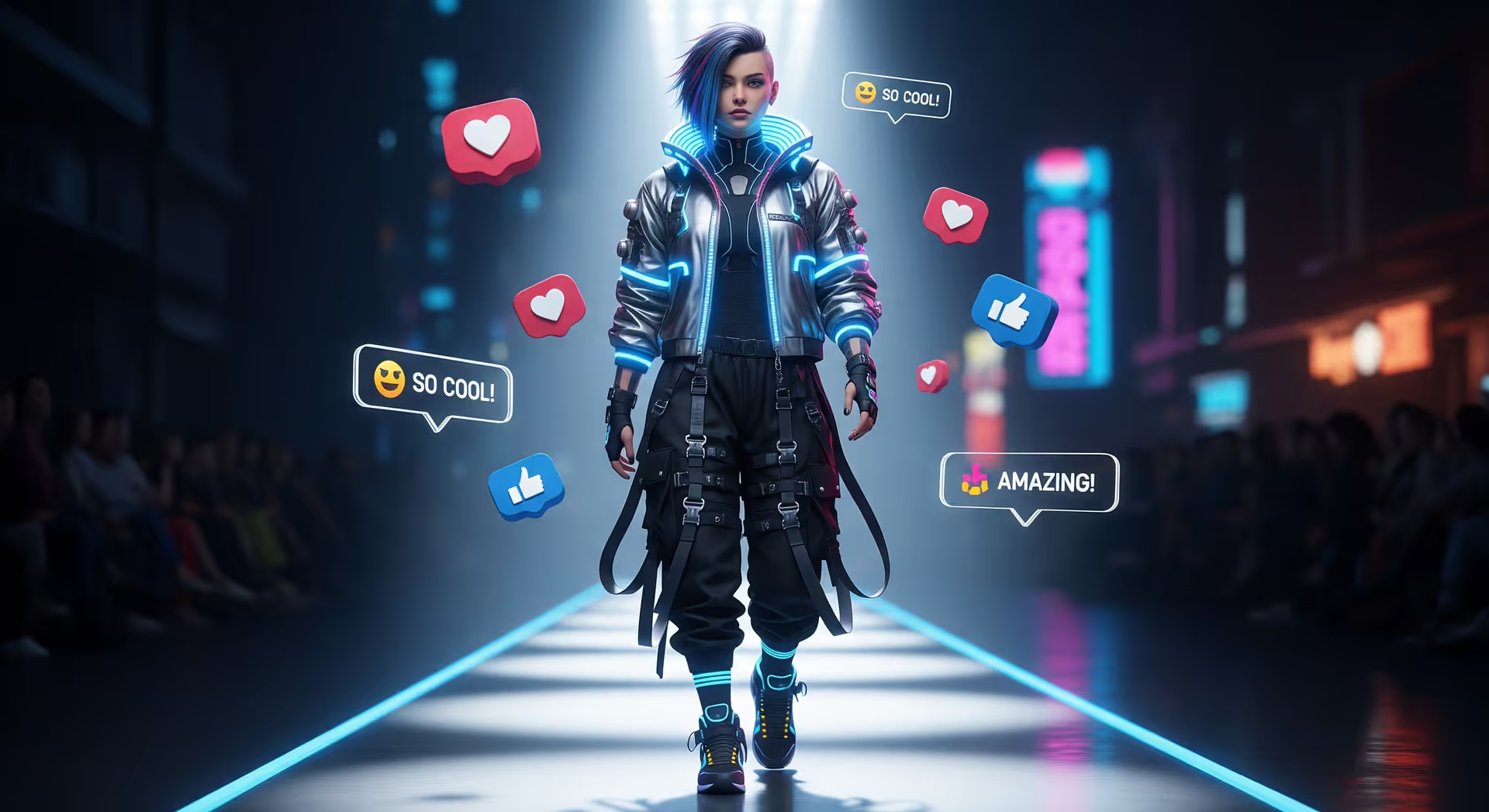
A virtual influencer is a persona produced on a computer, assembled with 3D modeling or AI image tools, that brands use to publish content and lead campaigns much as they would with a human influencer. Prada, Dior, Calvin Klein, and Balenciaga have each partnered with one. On price, the honest answer is that no set rate exists, and anyone who quotes you a firm, industry-standard figure is guessing.
This guide explains what virtual influencers really are, what genuine published market research has to say about the field, which factors move the cost of building and running one, how brands put them to work, and the disclosure obligations that apply once you do. For the wider case of AI avatars for business beyond a single named persona, see our companion guide.
What a virtual influencer actually is
The best-known cases are all real characters with proper names, not an abstract category:
- Lil Miquela first appeared in 2016, created by Brud, a studio based in Los Angeles. Her sponsored posts have covered Prada, Dior, Calvin Klein, BMW, Samsung, Tiffany & Co., and Pacsun.
- Noonoouri came to life in 2018, created by Joerg Zuber, a Munich-based art director, and has become a figure for brands like Balenciaga, Dior and Valentino (Brand Safety Institute). Her channel also campaigns on sustainability and animal welfare (XPLR Media).
- Prada's Candy is a digital muse the house debuted in 2021 for a fragrance campaign, appearing in print, in short film, and on social media.
Here is what these all share: the brand owns the character outright, dictates exactly what she says and wears, and never has to handle a real person's schedule, contract renewals, or an off-brand moment at 2am. That control is the actual trade a company makes. It is not a promise of bigger reach or stronger engagement than a human influencer, and nobody has published dependable, independent data showing such an advantage.
How big is the market, really
Market-size figures for a category this new depend heavily on how each firm defines it. Research and Markets sizes the worldwide virtual influencer market at $11.22 billion for 2025, with growth to $15.9 billion in 2026, a 41.7% compound annual growth rate. Read any single figure as one company's estimate rather than a settled fact. The direction, though, is consistent across the field: a market in the low double-digit billions and climbing quickly. (Source: Research and Markets, Virtual Influencers Market Report.)
What it actually costs to build and run one
Type "cost to create a virtual influencer" into a search box and you will find a long run of agency blogs, each with its own confident-sounding number. GRIN, which operates a creator-marketing platform, puts it plainly: "there's no set budget for these influencers," because brand-CGI partnerships are still new and pricing has not standardized. (Source: GRIN, "CGI Influencers: A Complete Guide".) That is the truthful answer, and it will not change until enough of these deals become public.
What does move the price, judging by what agencies that build these characters describe: how photorealistic the figure needs to be, whether it is a static image persona or a fully rigged, animated 3D model, how much original content it puts out each month, and whether a studio maintains it or the brand builds the capability internally. A straightforward, image-based persona is a very different job from a fully animated CGI model designed for video and motion capture, and the two are never priced on the same scale.
Because we build these ourselves, we can speak to what the work involves rather than what it costs on someone else's spreadsheet. Avril, a virtual influencer we designed and built end to end sits in our own portfolio. Our AI cinematic and motion design service handles character design, animation, and the ongoing production of content for a brand's own persona, shaped around what that brand actually needs instead of sold as a fixed package.
How brands actually deploy virtual influencers
Treat a virtual influencer as an addition to a marketing plan, not as a replacement for every human partnership you hold.
Brand-controlled launches. Product launches where the messaging must stay exactly on-message are a natural fit: a virtual persona will not wander off-script, and there is no risk of a scheduling clash or a controversial post arising from someone else's account. Prada's Candy campaign is one instance of this use case, a single, fully brand-owned character carrying a fragrance rollout.
Cross-platform presence. A CGI or AI-generated persona can appear on Instagram, in short-form video, and in augmented-reality experiences all at the same time, with no travel and no calendar coordination. Lil Miquela's assignments across multiple luxury and fashion brands show one character being reused across campaigns that otherwise share little.
Long-term brand assets. A human partnership normally holds for a few years before the person moves on. A brand-owned virtual persona, by contrast, does not age out and does not sign with a competitor. Noonoouri, working with houses such as Dior and Valentino since her 2018 launch while keeping the same identity, is the clearest example of that durability we have yet seen.
Paired with human talent. Some brands run virtual and human influencers within the same campaign: humans handle the emotional, first-person storytelling, while a virtual persona supplies volume and consistency. That is a deployment pattern, not a guaranteed cost saving or performance result, and any figure that claims to quantify the difference for "the average brand" should be met with suspicion until it names its source.
Disclosure: the rules that actually apply
The FTC's endorsement rules require that material connections, such as being paid, be disclosed, and that advertising not deceive the audience about who or what is speaking. Those rules were written with human endorsers in mind, and the base guidance does not yet spell out AI-generated personas by name. The underlying principle still applies regardless of whether the endorser is a person or a computer-generated one: an audience should never be misled about who is vouching for a product. If a virtual influencer promotes something, viewers should be able to tell that it is not a real person and that the brand controls the content.
Two newer developments tighten this further. First, Instagram and TikTok each run their own AI-content labeling requirements, separate from and in addition to FTC rules, so a virtual-influencer account has to meet the platform's label as well. Second, New York has passed a law, effective June 9, 2026, that calls for "conspicuous" disclosure when an advertisement uses a "synthetic performer": a digitally created asset built to look like it is giving a human performance. The law covers any ad that reaches a New York audience no matter where it was made, carries civil penalties of $1,000 for a first offense and $5,000 for each subsequent violation, and does not apply to depictions of named celebrities or of things that clearly are not people. Whether a given stylized CGI persona counts as a "synthetic performer" under that statute is a genuine legal question, not a settled one, so if you are launching a campaign that will run in New York, get counsel to examine your specific character rather than assuming either way. (Sources: Manatt, Phelps & Phillips client alert on the New York law.)
Do not build a virtual influencer from the likeness of a real, identifiable person without their consent, regardless of what any of these rules technically require. Disclosure is not a weakness. Audiences already understand that a virtual influencer is not a real person, and being upfront about it is what keeps a campaign clear of a deceptive-endorsement complaint.
The bottom line
A virtual influencer is a genuine marketing asset that the brand owns. It is not a shortcut to guaranteed reach, nor a cheaper version of a human influencer that produces the same results. The honest version of this decision has three parts: decide whether brand control and long-term ownership are worth more to you than the audience a known human creator already commands, budget for character design and ongoing content production as a real production line rather than a one-time expense, and build disclosure into the account from day one rather than treating it as an afterthought.
If you are exploring this for your own brand, our AI cinematic and motion design service is where we scope character design and production, and Avril in our portfolio is the clearest reference for what that work actually looks like end to end.
Sources
- Brand Safety Institute on Noonoouri (secondary source, checked 2026-09-14)
- Manatt, New York Synthetic Performer Law (secondary source, checked 2026-09-14)
- Research and Markets, Virtual Influencers Market Report (secondary source, checked 2026-09-14)
- XPLR Media on Noonoouri (secondary source, checked 2026-09-14)
Frequently Asked Questions
What is a virtual influencer?+
How much does it cost to create a virtual influencer?+
Do virtual influencers actually drive sales?+
What disclosure rules apply to virtual influencers?+
Want an AI brand ambassador working for you 24/7 without the influencer fees? Let's explore it.
Explore AI Visual ServicesAbout the Author

Rajat Gautam
AI Engineer and Consultant
My work goes far beyond recommending tools - I design AI systems that integrate directly into your workflows, eliminate inefficiencies, and deliver measurable business impact. Every solution I build is tailored, practical, and built with long-term scalability in mind.
Need help with this?
Visuals
AI Cinematic and Motion Design
We build the video system: brand templates, avatar and voice setup, and the review gate that keeps every output on standard. Your team produces the volume once it is built.
Explore service →
Visuals
AI Product Photography
We build the image pipeline for your catalogue: your SKUs, your look, your brand rules, wired into your product feed. Once it is built, your team runs the volume.
Explore service →
Related Topics
Related Articles


Ready to transform your business with AI? Let's talk strategy.
Book a Free Strategy Call