Sales Development Agents, The Future of Outbound Prospecting
Everyone's obsessed with hiring more SDRs to scale pipeline. But here's what nobody's talking about: your human SDR costs you $70,000 annually (all-in) to prospect 250 to 300 leads per month with a 1% to 2% conversion rate. Meanwhile, AI SDR agents are prospecting 1,000+ leads monthly at $3,000 to $5,000 per month with 3% to 4% conversions. And they never sleep, never burn out, and never ask for quota relief.
The companies crushing outbound in 2025 aren't just working harder. They're running multi-agent AI systems that are delivering 7x higher conversion rates than traditional single-channel approaches.
The Old Way vs. The New Way
The Old Way: The Manual Grind
Traditional outbound prospecting is a volume game built on human limitations. Your SDRs wake up, pull lists from your CRM, write personalized emails (or pretend to), make cold calls, update Salesforce, and repeat. The math is painful:
- Average SDR salary plus benefits equals $60,000 to $80,000, with total cost hitting $70,000 to $100,000 when you add tools, management overhead, and training
- Each rep prospects 250 to 300 leads monthly with average cold email response rates of 5.1%
- Open rates hover at 20% to 30%, meaning 70% of your outreach never gets seen
- Burnout rates hit 50% within the first year, creating constant turnover costs
- Personalization is inconsistent and scaling means hiring more people linearly
The worst part? Your best SDR still has the same 24 hours as your worst one.
The New Way: The AI-First Outbound Machine
Top performers in 2025 deploy AI SDR agents as their primary prospecting engine. Recent data shows companies implementing multi-agent AI systems are seeing 30% to 40% increases in pipeline creation, with some reporting 7x improvement in conversion rates over traditional methods. Here's how the model works:
- AI SDR platforms cost $3,000 to $5,000 monthly and prospect 1,000+ leads without fatigue
- Hyper-personalized messaging at scale using real-time data enrichment and behavioral signals
- True 24/7 outreach across time zones with instant follow-up on engagement signals
- Consistent messaging quality based on your top performers' best practices
- Sales productivity jumps 25% to 47% as reps focus only on qualified, engaged prospects
The financial gap is staggering. But the strategic gap is bigger. AI doesn't just work faster. It works smarter.
The Core Framework: Building Your AI SDR System
Phase 1: Define Your Ideal Customer Profile and Build Your Data Foundation
AI is only as good as the data it operates on. Start by clearly defining who you're targeting and why. Your AI SDR needs to understand firmographics (company size, industry, revenue), technographics (what tools they use), and behavioral signals (recent funding, job changes, product launches).
Use platforms like Apollo, ZoomInfo, or Clay to build enriched prospect lists. The goal is to move beyond basic contact information to contextual intelligence. For example, instead of "CEO of SaaS company," you want "CEO of Series B SaaS company that just raised $20 million and is hiring aggressively in sales, indicating growth mode and budget availability."
This data layer is what separates generic spam from highly relevant outreach that gets responses.
Phase 2: Deploy Multi-Agent AI for Specialized Tasks
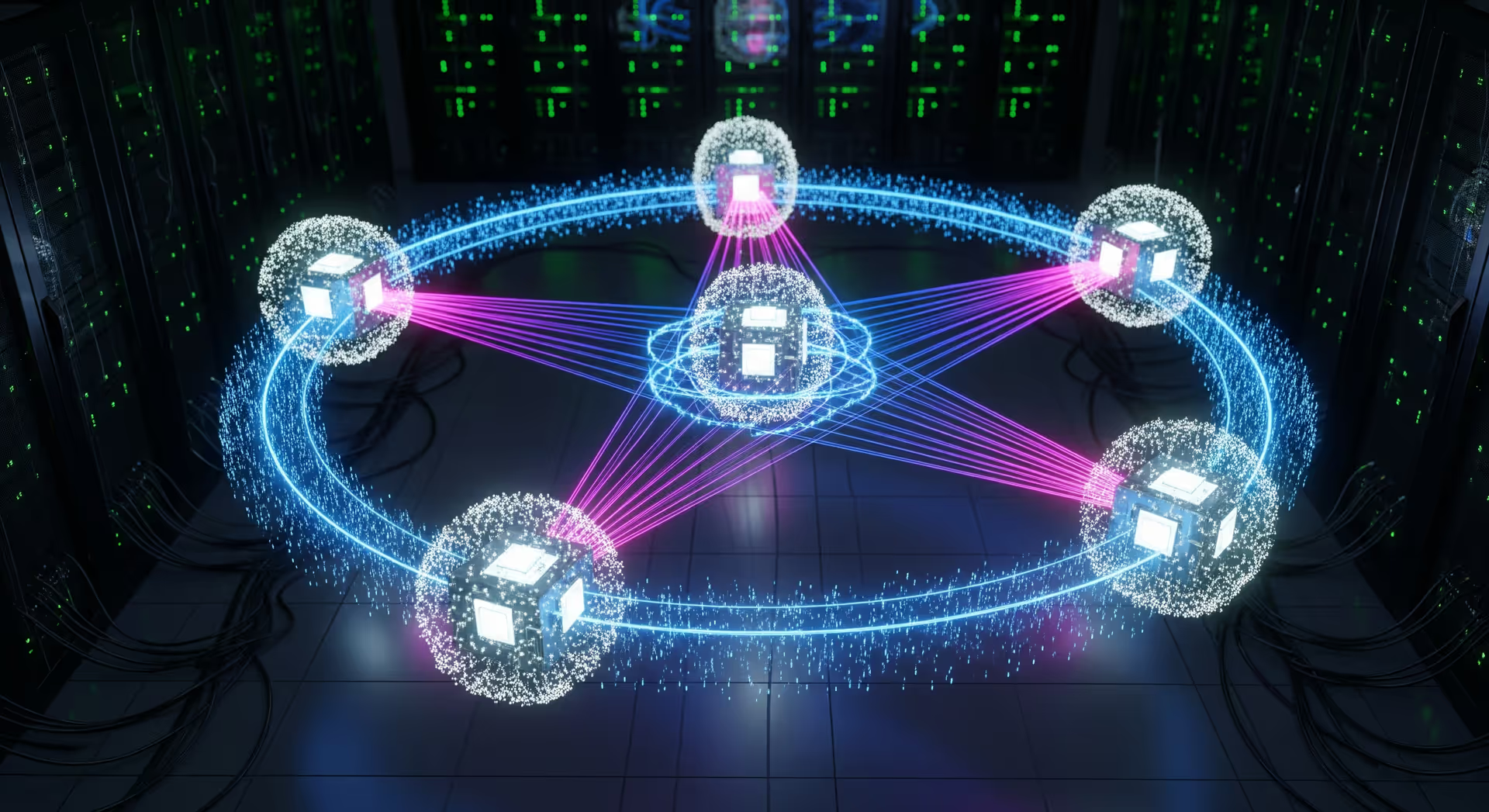
Single-purpose AI tools are dead. The breakthrough in 2025 is multi-agent systems where different AI agents handle specialized functions. One agent handles prospect research and enrichment. Another crafts personalized messaging. A third manages timing and follow-up sequences. A fourth analyzes responses and flags buying signals for human handoff.
Platforms like SuperAGI and Lindy operate this way. Instead of a one-size-fits-all chatbot, you're orchestrating a team of specialized agents working in concert. Recent implementations show this approach drives conversion rates up to 7x higher than traditional single-agent AI models.
The key is coordination. Your research agent feeds insights to your messaging agent, which triggers your outreach agent at optimal times based on engagement data your analysis agent is continuously monitoring.
Phase 3: Personalize at Scale with Timeline and Number Hooks
Generic cold emails get 3.9% to 4.7% response rates. Personalized emails using timeline or number hooks get 9.9% to 10.6% response rates. That's more than double.
What does this look like in practice? Instead of "We help SaaS companies grow," your AI crafts "Noticed you scaled from 50 to 120 employees in 8 months based on LinkedIn headcount data. Companies at your growth velocity typically hit bottlenecks in lead routing around the 6-month mark. Here's how three Series B companies solved this before it cost them pipeline."
Your AI SDR pulls real data (headcount growth, funding announcements, job postings, tech stack changes) and weaves it into contextually relevant messaging. This isn't mail merge. This is true 1-to-1 personalization at 1,000-email scale.
Phase 4: Optimize Handoffs and Continuously Improve
The biggest mistake is treating AI SDR as set-it-and-forget-it. Your AI agent should book meetings, but humans close deals. The handoff moment is critical.
Set clear qualification criteria. When a prospect responds positively, your AI should immediately route to the right account executive with full context: what messaging resonated, what pain points the prospect mentioned, what timeline signals exist. Top-performing teams are converting 20% to 30% of responses into booked meetings because the handoff is seamless.
Then use every interaction as training data. Which subject lines get opened? Which value propositions get responses? Which follow-up sequences convert? Feed this back into your AI system to continuously improve performance.
The Hard ROI: The Numbers Don't Lie
Let's calculate the real cost difference for a mid-market company targeting 10,000 new prospects annually.
Traditional Human SDR Model:
- 10,000 prospects divided by 250 per month per SDR equals 3.3 SDRs (round to 4 for coverage)
- 4 SDRs at $70,000 fully loaded cost equals $280,000 annually
- At 1.5% average conversion, you generate 150 qualified opportunities
- Cost per qualified opportunity: $1,867
AI SDR Model:
- 10,000 prospects handled by AI SDR platform at $4,000 monthly equals $48,000 annually
- At 3.5% conversion (conservative based on recent data), you generate 350 qualified opportunities
- Add 1 human SDR at $70,000 to handle high-touch accounts and complex deals
- Total cost: $118,000
- Cost per qualified opportunity: $337
Annual savings: $162,000. Opportunity increase: 133%. Cost per opportunity decrease: 82%.
And this assumes you're only matching baseline AI performance. Companies implementing the multi-agent systems with hyper-personalization are seeing 7x conversion improvements, which would push qualified opportunities to 1,050 annually at the same cost.
If your average contract value is $30,000 and your close rate is 25%, that's the difference between $1.1 million in pipeline (human model) and $2.6 million in pipeline (AI model). Same budget. More than double the output.
The ROI payback period is typically 60 to 90 days.
Tool Stack and Implementation
The Prospecting Data Layer: Apollo or Clay
You need enriched, actionable prospect data. Apollo gives you 250 million contacts with firmographic and technographic filters, plus built-in engagement tracking. Clay is better if you need advanced data enrichment pulling from multiple sources (LinkedIn, company websites, news feeds) to build truly custom prospect lists.
Apollo is faster to deploy. Clay is more powerful for complex use cases. Pick based on how customized your targeting needs to be.
The AI SDR Platform: SuperAGI, Lindy, or AiSDR
These platforms handle the core AI SDR functions: prospecting, messaging, outreach, and optimization. SuperAGI excels at multi-agent orchestration with specialized agents handling research, writing, and timing. Lindy is strong for teams wanting an all-in-one solution that includes voice AI for follow-up calls. AiSDR focuses purely on email outreach with strong personalization engines.
All three integrate with major CRMs (Salesforce, HubSpot) and cost $3,000 to $5,000 monthly depending on volume and features.
The Integration Layer: Make.com for Workflow Automation
Connect your data sources, AI SDR platform, and CRM using Make.com. Build workflows where new prospects automatically flow from Apollo into your AI SDR for enrichment and outreach, with responses triggering notifications to your human reps and auto-creating opportunities in Salesforce.
Make.com's visual builder handles the complexity better than Zapier for multi-step SDR workflows that require conditional logic and parallel processing.
Suggested Visual: A multi-agent system diagram showing Research Agent analyzing prospect data, feeding insights to Messaging Agent, which triggers Outreach Agent, monitored by Analysis Agent that flags hot leads for human SDR handoff.
Stop Planning. Start Prospecting.
While you're debating whether AI SDRs are ready, your competitors are already deploying their third iteration and scaling pipeline faster than you can hire.
Here's your Week One action plan: Pull your current SDR metrics (leads prospected, response rate, conversion rate, cost per opportunity). Calculate what 7x conversion improvement would mean for your pipeline. Then pick 500 prospects and run a 30-day AI SDR pilot using one of the platforms above.
The technology is proven. The ROI is documented at 10x to 20x in multiple case studies. The only variable left is your speed of execution.
Companies that deploy AI SDRs in Q1 2025 will have 6 months of optimization and learning before their competitors catch up. That's not just a pipeline advantage. That's a market position advantage.
Related Topics
Related Articles