
Multi-Agent Systems in 2026: LangGraph, CrewAI, Agent SDKs
Key Takeaways
- →A multi-agent system splits one task among specialist agents instead of one agent doing everything.
- →LangGraph gives explicit state and control flow and is the most widely used choice in production.
- →CrewAI is quickest to prototype but thinnest on production observability.
- →Most production systems blend hierarchical, collaborative, and sequential coordination patterns.
- →Production needs evaluations, observability, guardrails, failover, and SLAs, not just a working demo.
On this page⌄
A multi-agent system divides one task between several dedicated AI agents rather than having a single agent handle everything. In 2026 the realistic options come down to LangGraph (clear state and control flow, the most widely used choice in production), the OpenAI Agents SDK or Claude Agent SDK (for teams already committed to one model provider), Microsoft Agent Framework (for those running on Azure), or CrewAI (quickest for prototyping, thinnest on production observability). This is how to decide, and how to construct one the right way.
Three things are worth reviewing before going down this path: what an AI agent costs to build and run, agent security, because a single compromised agent can compromise the rest, and agent memory, because agents must share or separate what they know.
Before moving up to multi-agent orchestration, it pays to first look at how a single-task bot compares to a multi-step agent.
Why one agent fails on complex work
A lone AI agent that takes on customer support, data analysis, compliance review, and operations at the same time turns out mediocre results across all of them. It fills its context window, loses state between turns, and demands human input for work that ought to run without supervision.
A multi-agent system splits that same work among specialists. A research agent collects information. A reasoning agent interprets it. An execution agent carries it out. A verification agent compares the result against a recognised good baseline. They work together through a shared state, an orchestrator, or a message bus, depending on which framework you choose.
This shift matters because complexity in business processes does not grow in a straight line. Adding one extra domain to a single agent tends to hurt performance in every other domain, since context windows get more crowded and reward signals get less clear. Dividing the work gives each agent its own clean context and reward for a single job.
Three coordination patterns
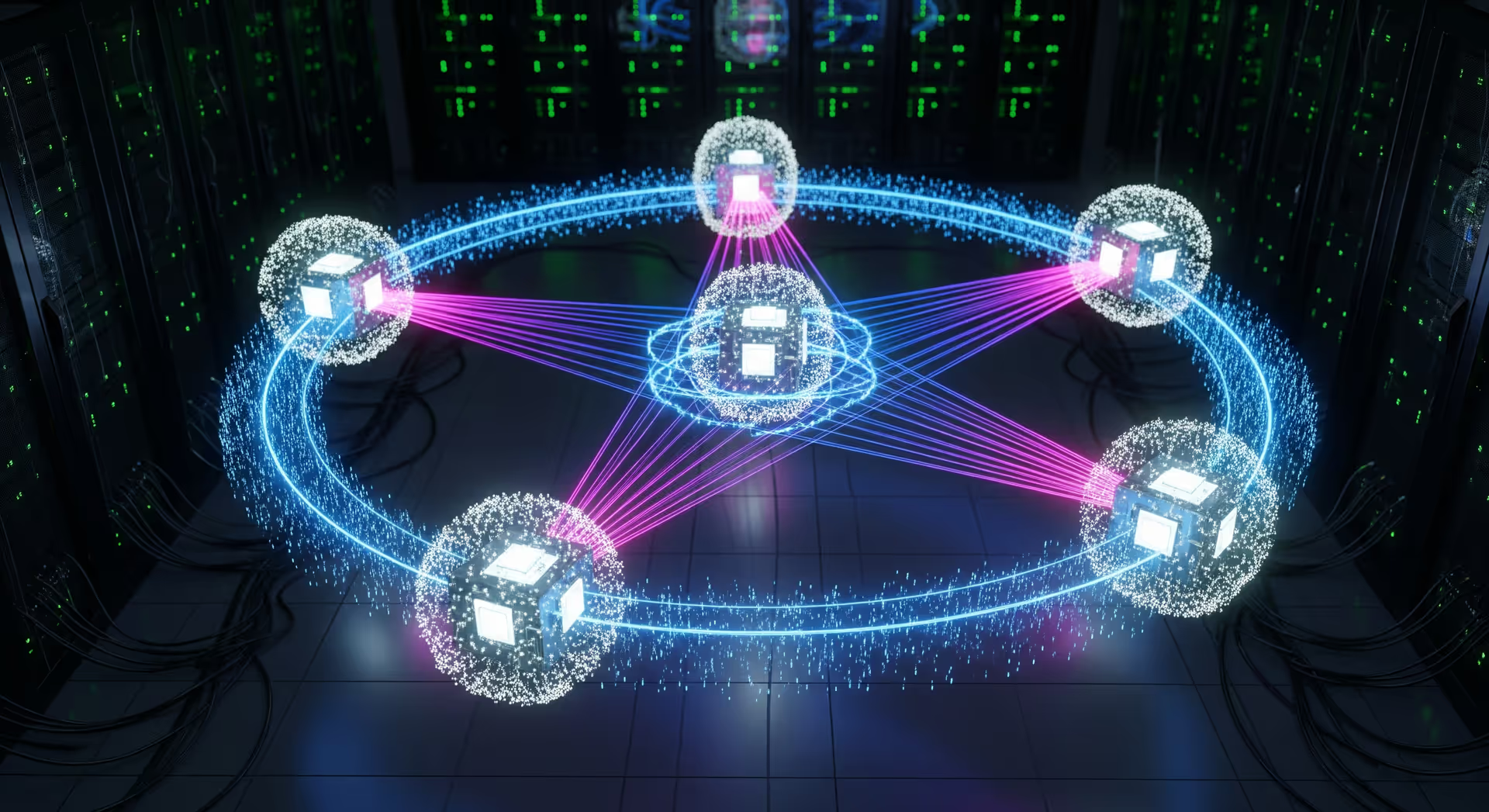
Multi-agent systems coordinate in one of three ways. Most production deployments blend all three.
Hierarchical delegation. One orchestrator agent takes the objective, splits it into subtasks, hands each one to a specialist agent, watches progress, and combines the results. Picture a project manager running a team. A predictive-maintenance setup might pass vibration analysis to one agent, temperature monitoring to another, oil-quality scoring to a third, and production scheduling to a fourth.
Collaborative problem-solving. Several agents work on different parts of the same problem at once and then pool their findings. In a fraud-detection pipeline, one agent scores transaction patterns, another models account behaviour, a third looks at geolocation signals, and a fourth checks past-fraud markers. They merge their scores into one confidence rating.
Sequential pipeline. Each agent feeds its output to the next agent as input. A customer-support flow might start with an intent classifier, then a retrieval agent that finds relevant past tickets, then a response composer, then a quality verifier that rates the response before it ships. Sequential pipelines are the simplest to debug because state moves in a single direction.
Single Agent or Multi-Agent: A Decision Table
| Question to ask | Stay with a single agent | Move to multi-agent |
|---|---|---|
| How many domains does the task span? | One domain, one job | Several at once, such as customer support, data analysis, compliance review, and operations pulling in different directions |
| Does the work fit in one context window? | Yes, one clean context handles the whole task | No, the context window fills up and state gets lost between turns |
| Can the output be checked? | Only a person can judge whether it is "good enough" | The output can be checked against a rule or a known answer |
| Does the workflow divide cleanly into specialists? | No natural split exists yet | Yes, for example a customer-support flow that splits into a classifier, a resolver, and an escalation agent |
| Is your observability wired up? | Not yet, wire it before adding any agent | Already wired from day one, so you can debug what breaks |
Add agents gradually rather than all at once: bring in a new specialist only once an existing
agent starts dropping a specific type of case, not before.
The Three Coordination Patterns, as Text Diagrams
Hierarchical delegation (the project-manager pattern)
Example from the post: a predictive-maintenance setup.
\`\`\`
Orchestrator
(splits the objective,
watches progress, combines
the results)
|
+-----------+--------+--------+-----------+
Vibration Temperature Oil-quality Production
analysis monitoring scoring scheduling
agent agent agent agent
\`\`\`
Collaborative problem-solving (the parallel-and-merge pattern)
Example from the post: a fraud-detection pipeline.
\`\`\`
Transaction Account Geolocation Past-fraud
pattern agent behaviour agent signal agent marker agent
+--------+--------+--------+--------+
|
v
Merged confidence rating
\`\`\`
Sequential pipeline (the simplest to debug, state moves one way)
Example from the post: a customer-support flow.
\`\`\`
Intent classifier --> Retrieval agent --> Response composer --> Quality verifier
(routes the (finds relevant (drafts the reply) (rates the reply
inquiry) past tickets) before it ships)
\`\`\`
Where the pipeline pattern already earned its keep
Multi-agent design did not come out of nowhere. It is the current form of an approach finance and healthcare already validated: break one difficult process into narrow stages, and verify each stage before the following one starts.
Legal contract review. JPMorgan's COIN system is the canonical example, and it came before today's agent frameworks by almost ten years. Bloomberg reported in February 2017 that COIN's document-review software reviews commercial-loan agreements in seconds, work that had consumed 360,000 hours a year of lawyer and loan-officer time ("JPMorgan Software Does in Seconds What Took Lawyers 360,000 Hours", Bloomberg, 2017-02-28). COIN was not agentic in the modern meaning, and the Bloomberg piece draws no conclusion about how the work was divided up. Our reading of it is narrower than that: a review job that had been one undifferentiated pile of lawyer hours became tractable once the software was pointed at a single, checkable task instead of the whole contract. That inference is ours, not Bloomberg's. For more on the legal vertical, see AI for law firms.
Clinical documentation. A 2025 paper in the Journal of the American Medical Informatics Association (Shah et al., "Ambient artificial intelligence scribes: physician burnout and perspectives on usability and documentation burden," JAMIA 32(2):375-380) reports a prospective quality-improvement study at Stanford Health Care in which 48 physicians used an ambient AI scribe for three months. The tool recorded the visit and returned a draft note already split into four separately populated sections: history of present illness, physical exam, results, and assessment and plan. The physician reviewed and attested to the note before it was signed, so the split existed to make each part separately checkable. Paired survey responses (n = 38) showed statistically significant falls in task load and in work exhaustion. It is a single-site pilot measured by physician survey rather than by independent audit, so it is not evidence about observability or audit trails in particular.
Insurance claims triage. A claims-handling pipeline can chain an intake agent that extracts loss details, a fraud-pattern agent, a coverage-verification agent that checks policy terms, and a settlement-recommendation agent that suggests a payout band. The audit trail is the tricky part. Without one, no regulated carrier will put this into production.
Property management. Tenant communication, maintenance triage, and rent-collection follow-ups can operate as a sequential agent pipeline with human escalation for edge cases. The payoff is steady tone and round-the-clock response time, while a person still makes the calls on negotiation and exceptions.
Customer support. A three-agent system of classifier, resolver, and escalation is the usual production starting pattern. It only works if an evaluation suite checks the resolver's accuracy at each step before it goes live.
The common thread across all five: choose a workflow whose output can be checked against a rule or a known answer, not one that only a person can judge as "good enough."
The 2026 framework stack
The framework debate has moved on from the older habit of pairing CrewAI for orchestration with AutoGen for code-writing agents. Here is what the main vendors actually deliver in 2026, and when each one is the right fit.
| Framework | What it is | Use it when |
|---|---|---|
| LangGraph | Graph-based control flow: explicit nodes, edges, and state, built for stateful multi-agent systems. Integrates with LangSmith for tracing and supports human-in-the-loop pauses. | You want explicit control over routing, retries, and failover, and production debugging matters more than a fast demo. |
| OpenAI Agents SDK | OpenAI's orchestration framework, built on the Responses API. OpenAI began deprecating the older Assistants API in August 2025, with a one-year sunset window. | Your stack is already anchored on OpenAI models and you want first-class tool use and tracing with fewer integration points. |
| Claude Agent SDK | Anthropic's Python and TypeScript library for building agents, formerly shipped as the Claude Code SDK. It runs the same agent loop, tool permissions, and subagent model that power Claude Code itself. | Your agents read long documents, run multi-step tool chains, or need Claude's tool-use and permission model out of the box. |
| Microsoft Agent Framework | Microsoft's successor to both AutoGen and Semantic Kernel, unifying AutoGen's multi-agent orchestration with Semantic Kernel's enterprise features (state management, telemetry, type safety) in one SDK. | You are an Azure shop and your security review only signs off on Microsoft-supported infrastructure. |
| CrewAI | A role-based abstraction: define a "crew" of agents with roles and let them collaborate. The easiest of the group to explain in a stakeholder meeting. | You need to prototype a role-based workflow fast and observability is not yet a gating concern. |
AutoGen, Microsoft's original framework, is now in maintenance mode. New projects should begin on Microsoft Agent Framework; existing AutoGen deployments should schedule the migration before the next renewal cycle rather than after it.
The engineering discipline that separates a LangGraph or CrewAI demo from something you can run unattended stays the same across frameworks: explicit state you can inspect, a retry and failover path for every external call, and a trace you can replay when things go wrong. Choose a framework for how well it provides those three things, not for which one has the friendliest getting-started guide.
What "production" actually means
The distance between a multi-agent demo and a multi-agent system you can run unattended rests on five factors.
- Evaluations. A golden dataset of representative inputs with expected outputs. Run on every change. Regression-block deploys.
- Observability. Per-step traces in LangSmith, Langfuse, Helicone, or your own logging. You cannot debug what you cannot see.
- Guardrails. Prompt-injection defence, output validators, and refusal hooks on every external-input agent.
- Failover. Deterministic fallback paths for when the model or a tool API is down. Most teams skip this and learn the hard way.
- SLAs. Uptime, latency, and accuracy targets with reporting. If you cannot state your service-level targets, you do not have a production system yet.
For a closer look at the integration patterns that enable this across Epic, Clio, Guidewire, NetSuite, and comparable platforms, see our AI integration depth services.
Building your first multi-agent system
Begin with a workflow that divides cleanly into specialists. Customer support is the standard place to start.
Deploy three agents:
- A classifier that routes inquiries to the right department or tool
- A resolver that retrieves relevant context and drafts a reply
- An escalation agent that detects when a human is needed and hands off with full conversation context
Wire each agent into your observability stack from day one. Without it, you are flying blind on accuracy.
Measure resolution time, accuracy rate, and escalation rate against your baseline before automation. Scale gradually: add a specialist agent only once the resolver starts dropping a specific type of ticket, not before. Treat the system the way you would treat a growing human team. For a full deployment walkthrough, see deploying customer support agents.
Pick one workflow this quarter. Map the specialists. Build the smallest viable team. Wire the observability before you wire anything else. Ship.
When you are ready to take a production-grade multi-agent system from design to deployment, explore our AI agents and workflow automation services.
Keep reading
For the strategic picture on agents, read what AI agents are and how they differ from automation.
For a hands-on first build, see building your first AI agent step by step.
For the customer-support deployment pattern specifically, see deploying customer support agents.
Ready to take the next step? Book a free strategy call or explore our AI agents and workflow automation services.
agent/).
For the customer-support deployment pattern in particular, see deploying customer support agents.
Prepared to take the next step? Book a free strategy call or explore our AI agents and workflow automation services.
Sources
- Bloomberg, 28 Feb 2017 (secondary source, checked 2026-09-14)
Frequently Asked Questions
What is the difference between multi-agent systems and single AI agents?+
Which multi-agent framework should I use in 2026?+
How do LangGraph and CrewAI compare for multi-agent systems?+
Is CrewAI still a valid choice for production multi-agent systems?+
What does observability look like for a production multi-agent system?+
Can multi-agent systems replace human teams?+
Ready to deploy a production-grade multi-agent system with evals, observability, and SLAs? Let's architect it.
Explore AI Agents + Workflow AutomationAbout the Author

Rajat Gautam
AI Engineer and Consultant
My work goes far beyond recommending tools - I design AI systems that integrate directly into your workflows, eliminate inefficiencies, and deliver measurable business impact. Every solution I build is tailored, practical, and built with long-term scalability in mind.
Need help with this?
Related Topics
Related Articles
Ready to transform your business with AI? Let's talk strategy.
Book a Free Strategy Call